
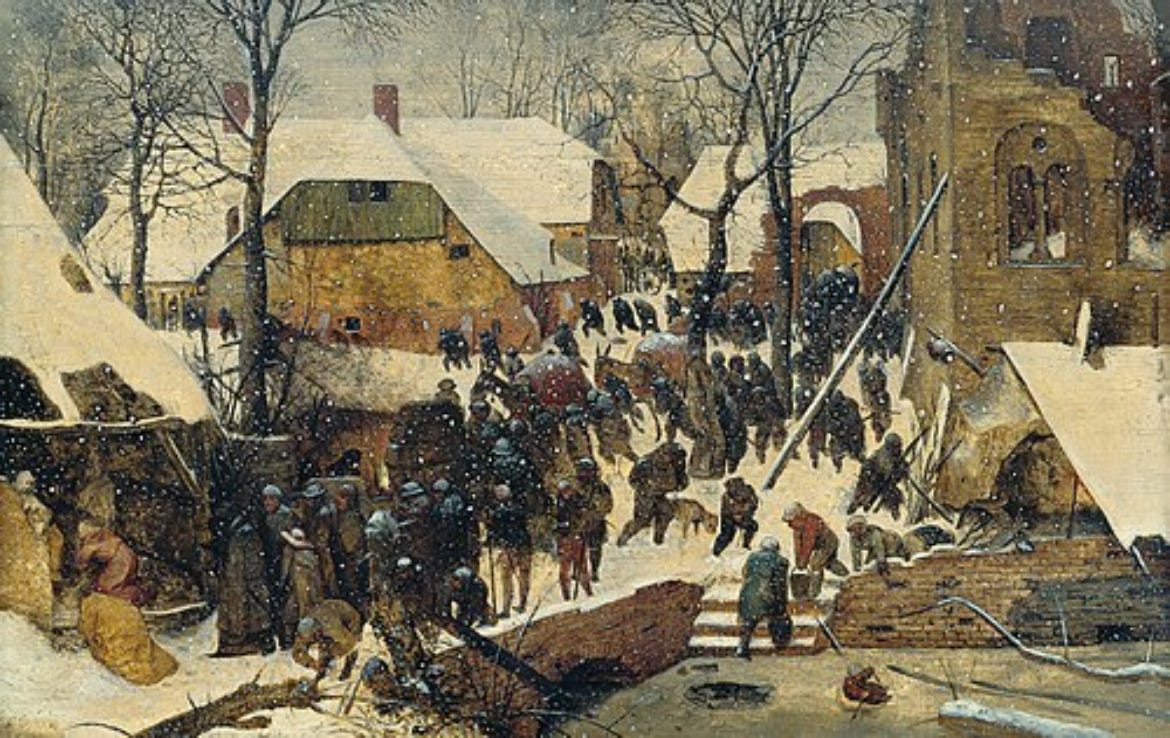
Look at us, Brother Sam.
Speaking to you, blenchless and with venture, in arris, vulnerability, sally (No, we come not wet from Pearl Street, though the air and Vigil sometimes dress as the substance).
What might say Mr. Burnet, our antipathetic man (Remember, always, that quarrel is incapacity’s genitor)? Why, he’d call us Adolphus the Weeds, Stephen the Mouth, Pieter the Crook.
Hoe dan ook. We are Silk with privilege, with the Means’ of Prerogative. And so, natally, are you (though not by Order of Volition). And so, too, our hassocked, patrimonious, self-exhausted Governor - with that cathedralic orb, that Strabismus, from which he peers - flourishing his Yellabelly tutor as he spirits forward one of Preceptor Newton’s airy ciphers or coadjutes with the vari-deported Wilden.
The 27th of December in The Year of Our Domain 1723, Albany, Oud Beverwyck - our Dutch-Caledonian protectorate - the Prime Minister’s (or, that Fast-Lipped Exchequing Norfolkian) Accountancy, the King’s (or, that ministerially disinterested Hanoverian) Empire.
To Adolphus Philipse, Stephen de Lancy and Pieter Schuyler; in confessed interfaciality, in non-resistlessness:
First was love - substance and subject but, too, those umbrageous places from which it flees or falsely inhabits; and then, that chained exigency to be contributory; and, later - and from the initial command - the prided self-conceit for truth (which, seeming and coactive, are catechizations and conscious terrenities each). So is it for these purposes that I tempt myself to defend our Governor? For animal goodness - that purportion of charity, that desire for knowledge - because I lack the square civic dependableness and artistry of power inferred to each of Your Prominences? Is it for reasons of Holland, of the Great Whig - crowned by the British Koning - or, yes, that exegete of fathomability Mr. Newton?
Less than I scruple to the weight of this dispatch that travels to me up the North River. I intend to dissimulate, but first: Upon which wind did it fly? From under the steep, crural depths of contempt for one of Philip II’s toques? Bottled by a handful zander in the Markermeer? From one of the bewetted, off-Battery Brewworks? Não. You splayed at the cupola-neath tavern on Wall and Nassau, in Society; Stephen cognomenously (and derisorily) titled it Stadt Huys, a squeeze upon low-Germanic peoples and, too, the omni-Southron.
Curious, our tender swelling, but, too, our magnification of prejudice; the Huguenots, tribal and premonitory; that north-of-the-Oceanus Brittanicus agglomeration of Saxons, Normans, Britons and the Gallic evanescent we call England, emotionally inhibitive and tyrannic in ways native to the unconquered (it practices like guilt); the Jesuits, lachrymose.
And, of course - Adolphus and Pieter - the Dutch: vulpine, landed, bested.
I can only gather you’ve so written to me - hand corpulently to Hlaf, feet to fire like the gelid-boned suidae, mouth to world like a house-compelled Oranje - on the part of my passion for those predicaments of Origin and Motion. For why would men of such Arete and peermanship bid me?
I
I last heard of the Centenary when I was at the Kip burg this late summer; but the act of recognition itself - in stead of the jollity of its speculation and dilation - smelled of inconclusion, of a passive, elliptical negotiation. No one could dictate for me a procession or program, granted that the Spring of ‘24 - that Proem to Light - is, indeed, the hull that kissed or punched the foreshore we seek to observe (and bless the Curses, and damn the Benisons, of that concomitance). Quiet, rutted - and on account of your willing and curating it - I shall take and analyse a minority of those acts, which, to state prefatorily, can serve only as temporal ceremony for quintessence (and quintessence seeks time only in that time occurs within). That famed spring, built upon an earthen heel of perception and exudation, and amidst a barnful of foregoing infatuations, ideas and contrastive spaces; which, I divine, is why you chose mij for these Medial Duties (and am I so equipped for such an abridgment)? In sheer sensation, we are but a Mahamanvantara from our enthroned, Behistuni begetters, from Un Grand Village.
-
In citation: Could even a slight fraction of Century Eighteen’s animate so successfully cite - on a Map of the betided and pending - what might a Walloon be?
A turnt definition; and chiefly, I gather, because the phrase does not draw complete topologick incertitude. Colonists, of course, recall the boil-pated, ink-hearted Petrus Stuyvesant. But what of that unsecure (in person and in membrance) episto-versificator Jessé de Forest? Inauguration - even if near-buried - grosses a seat in memory. Cardinally, this is memory: those thin viaducts widened, tendered and, so, remunerated, whether of true petrous impact or due to the natural cumulation of state Desiderata; a luminary quality that marks the lone prosperity of the Walloons, substantial in self-concept and untenanted in circumstance, social accruement or advantage: at Rome, upon the Straße, in Pays Wallon, at Leiden, at Fort Orange, at Noten Eyldandt and, finally, Nieu Nederlandt, and further substantiated in gold and dark by the glass-faced Picardian, his recency victualling his oddity - cold and alive as a strange-beat time that double-folds, inspissates, circumprogresses - so that Christ and Calvin himself ocularly appear as vary-vying cousins, the older, incredibly, acceding to the junior (his prophecy but, too, his corporeality, that same Mortal Impermanency that lanced and transfixed Servetus to the black of the fire) in a nightmare’s conciliation of a whole Millennium and Quincentenary.
Such are some of the heritances upon mine own hands, afflicted by the lapidified wood, the rolled potash, clubbed viands, the booted-over-humus of the coming grain, the glass-jailed rum (pounding and dispersing like the saturate between Plymouth and St. John’s Harbour); inheritances that so roll along through the conduit, out and away from one’s own imperative upon present living, so that what remains might be perceived as reverse-conic, coming not from a barbed locus of prominent ancestry or Jacobean writ but from the corn or kine, from the Wide Beneath, profitless because it buys one from void and discord but, too, from the whole of the ancestral membrane, subaqueous to the tight-bobbin-laced, chemise-sunk lap of Mère; dictating, upon the settlement’s cold and doubt (assonant, and yet, gifted with a certain Arminian ambulation), You chose not me, but I you.
-
Like a true descendent of travelers, de Forest charged and retreated from bastard Habsburgs, from inward-burning Capetians, from windshadows. Here again arrives the Picardian, not teaching but indeed situating us: to sense variance among the Voluptuary, to intimate animus toward the Treatise-Betraying.
Lo, in the eleventh year of the previous century - following Henri’s forever summer (that Holy Martial Static) and those many Synodalists spleened amidst the Good King and Philip - fell the great Bourbon, and so too the communal and commercial laxations built upon the Edict, and so too enlightened, Eudaimoniac ministration to fear, bore and Politique; and so too, for de Forest, France. How, even with family, he shed all assimilatory temptation. How he passed through those great European burgs of thalassic technology and law. How he crossed the Haringvliet.
Leiden: that basal Wilderland of the devoted and discordant, of Zealots, Zionists, Anti-Dualists, Merchantmen of a certain dimensionally nonspecific Phoenicia, Adventurers, Love-struck Geometers, Chimerical Theologians, Lusophonic Jews, and all other formations of the extricated, unsquared mind. A printing press per Paideutic, entitling acts of joinery with radians wide and many; the place of liberty, of the heavenly umbra, of surfeit; of the lean, strict, piquant, competitive-hearted, Tykean man.
-
Plump - or perhaps so spoke the sudor - labially handsome, and in the seeming presence of a yet-wrought vital debt, Robert Cushman, Man of Kent, toured the Steenschuur, his overgown casting off ghostly reticella, his hands glassed in the depthful bone of farthingale. He had not that pileous Yorkshire grey (that gnostic disabuse of martinet, liberal, Materiaal and mortal), his Cutis woken with a westerly steam and algor from which came the idea of production and gainfulness (if not Mr. Bradford’s piety), and, too, the sadness and resilement of a Rapenburg-side hosteler, of a Canterbury pilgrim in the consequence of yet another movement.
“I am bolted and assured by these gruit mixtures in the lowlands,” Cushman spoke to his new Confrère.
“If not,” countered de Forest, “by the nature of their Savour.”
“I care not. Does it taste of a sweatful sheep? And vitally - and what feels like increasingly like a solemn controversy in England - does it turn me soporific?”
“I gather this is the particular worry of a large-burg Broker -”
“Do you malign London, de Forest?” with a leer belatedly arriving to gay mordacity. “Do you so freely insult the rightful and honored George Abbot?”
“And, further, that your people remain enthralled by such Zones of Gamesmanship and Legitimacy, by that cautioned perpendicularity.”
“You could not have gathered, de Forest, that Ethics be the World and not the finger?”
“And, let me surmise: that Gallic culture be one of The Finger.”
-
A more haptik lane they might have sailed had they been but a few years above twenty. But lo, the mind approaches the Empyrean, the body expiry; and while that next voyage might so complete you, such Men, brine-scented, must volunteer as God’s executors of art in this yet-Shown life.
“De Forest, to where will your people end?”
“Hopefully, if so ordained, to that place of consummation and planarity.”
“Arminius condemns you.”
“And you?”
“Before my foreorigination? A cold beach of pillowy, crystalline sand if I’m of fortune.”
“Or, endued, an Antillean kelp pall.”
“Virginian if of luck.”
“And will Robert the door batterer exercise the taciturnity to gull hencoop-bound shareholder Londonmen into delusions of Studium and command?”
“I would be keen to see you labor in such conditions, surrounded by those who think the Lord is a pendant or gold choker.”
“But of course you do not cognize the irony.”
“That I trade in monies?”
“That the Walloons are, too, accused of being pearl merchants.”
Willem Usselincx was a person of ministry, of idea and hardihood, of group maneuverings, of the Globalscopic, of explicability, and, too, of exile, reprobate, land snatch and Cozenage, of the Templaric adventure’s final desultory Teleologia, of witless defeat after witless conquest. What might one call the postulate under which things have been too protractedly endured, begging for either superior sufferance, silent sufferance - falsely transcribed, though leaden, as none at all - or death? And what do exhibitors of silent sufferance pursue? That tergiversation from finality (but, too, its more beauteous sibling: Conversance, Wakefulness) which creates and braces power. The animal desires it, Man knows and values it, and the corporate parson digests it, and through those sapiences the very Irration one puts toward reproduction, oblation and Seideling goes, instead, toward that punctilious assimilation of mind and action we might call placemaking. Such encompassed the seriousness that shrouded Usselincx, highly effectual, if emulous, if, and he sought not to focus on the Pathetic - After warning him once and then twice, have nothing more to do with him - it did evoke diminution; a rebel with a mind toward Sanction (Code, Contract, Charter, Treatise) like it were the knife or boot, the land and body, that final intercalary Houd Fast before Peace.
“Ask de Houtman,” Usselincx’s face rounding and balding toward Seraphic affectability before remitting to a fallen-eyed Belgic V. “Ask van Neck, ask the Sumatran, the Ambonese, ask His Grace Akbar, if the spice finds or even seeks the stew.”
-
“And what, finally, halted its viability?” asked Usselincx.
“Let me venture,” spoke the elder Petrus Plancius, famed Mapper and Ouranist. “Not failure, not nonperformance, not dereliction.”
“Death?”
“A conviction or prospect of death?”
“But might that Plinthian fear prove scientific certitude unwinnable?”
“Well,” Plancius hesitates. “That is too the case in the webbing, blotting tropics; though less so, in admittance, than when the chill overreaches wale and breasthook or the hull recoils off the ice.”
“As in Psalms,” said Usselincx, “When the sun bardically forsakes the tired, desperate expedition.”
“Bardic in its profundity?”
“In that on all days, the sun encounters Darkness.”
“And membrance that Circa Diem loss will lead to the Final Loss?”
“You’re encountering my primary perturbation with divine omniscience.”
“That man pet the wrong scute?”
“Yes, and now fears the aforesaid resilement (and whether it might lead to the remnant of the Ijsberg or to a Bowhead fin or the distant threatening bluntness of the Skeggøx) or a genus of Destiny far more menacing: one of Hyperborean Static.”
“You are describing the whole of the Northwestern Mystery.”
“Yet: There is no Northern Orient. There is only Nyenschantz —”
“Indeed, is that a Mughal brocade upon you?”
“There is only the widening strait. Let us all be ground-hardened Norsemen.”
“The merchant has many forms - enlivened, inventive - but one I do not relate to him is Valor. The only hypothesis for their encountering the Ijsberg is poor helmsmanship.”
“I endeavor to leave such questions of aptness to the Woken and Seeking.”
“And who: Hudson?” Plancius, in knowledge of his thick reputation.
“Insofar as the northerly expeditions require a tyrant much like the southern ones necessitate Georgic Technicians or brawn-bearing Firemen.” Usselincx need not concur or further judge or reflect, sympathetic to that irreconcilability between the extraordinary-functioning and those chemical-spiritual convolutions (for everlasting calm bears the sonic quality of a Nicomachean game, in service of a more critical warning) which cost men the affordance of pleasure just as they afford them the potentiality of being he which finds: that plying, negotiating line, that corridor, that (a word more alary, more Aeolian, than substantial) Passage.
September 1609: through vaporous, alabastrine air the Crew and their inward-pointed Louvois, their Augustinian wayfarer, look out upon a fissured bay. Here a waterway, and there - and similar to a game of Gilet, where one empties the stellar purse for one, but possibly the wrong, lode - Terrenity. Hudson selects (to cross-coaxing and dog-tired fettle, to dream and apprehension, to flanking viridescence) the westerly passage as the sanguinity and cupidity of the men that succeeds the river’s distension at the Tappan Zee is soon followed by deviation and Taper, by shock at the sight of animacies upon the riverfront, incredible but for the Anamnesis that you live by that Art of God.
II
As my father took part in De Nieuwe Wereld, I too expended taught labor (though labor of the Caravansary, rather than the field): that of Youngest Boy for my hard-eyed, basalt-haired Walloon-Huguenot mother, a doll-like donative function, playing Marais on the viol and other conformations of Lully on the gitarre; like a Catholic Man of Expertness and Obsequity, not a first century Roman, but still, a Personage, like and different from my father, dancing, smiling, seed-planting; mining, unnaturally but necessarily, medial gray-bearded intonations upon village ministration and Judicature, matrilineality among the Haudenosaunee. Those painful flexes, those instances of Smertan, his and mine, of what I might define as shame in the face of our triumphant homing; and more ill-solvable - and yet another natal Generatie advanced - when you contain the many-homed blood of the American. I might be described as piece with that maiden colonial Generation. What art thou? Well, for many a year, ephebic, ripped by descendancy, chimneyed by those natural palisades of Origin and moved by a durating love for my distaff artificer. I perfused the acorn with that song of soulchase, of dark and distance’s Ambire; a bastard of shape - a loved, white-slated bastard of shape - quintessent of the lot.
To retard the deceptions and affectations of my speech, to stretch at my more dissimulated self, to avoid the eye of my cloth-discerning elder sisters and brothers - of Mine Own Word - I found books, abandoning song, moving seldom, amassing and mislaying time, widening, body and smile each, weighed, J’étais, by Septuagintal integrants, madenned by self-mastery (not its rectitudinous product but by its procedure) and the abstemiousness of Mark, acceptive of improminence, chagrined by Man’s odium, impaled by that blackened love of a son’s death, bowled forth by excel in comprehension (that the act of hand-raising-book is not good-minded for toil spent, but for ego submitted, and, thusly - and to return to that infinite, pre-supernal Vanity - the prospectuses made imaginable), by paternal practicality, by the vulnerability of my and Margrietje’s companionship, where, not three and twenty, we married Upriver - away from the Landgoed and the easterly Kips - a marriage of beloveds but, too, of stinging, gelid Albany, of the slantshot life, of strange-pullulated wheat, of the phatasmic Wilden – indeed, a life and ambition insuperable without her Hestian excellence; I range - nay, I ingermanely maunder - but for that Square.
-
Grandpapa - the one, familiar through word and attestation, to you men: the honorable Hendrick Kip - was said to have dubbed me Vrolijk before his passage, a gladness I at least spake and sought to equalize; for such a stance would have naturally destined me a creator but not a protector of my own work, Sateen Modesty in the stead of Bloodfull Pride. But my mother was mistrustful of Dutch non-candor, conforming and regarding me as she might a loveful Oat, smart and ultimately forgiving, if not precipitously so: honest, a face-to-the-Sancta Sedes Thomas More; humble, much like the watched upon; unbent.
He, Grandpapa, was a kind, strong, controlling, conceited, competitive and connected man, one who’d perish out upon the quiet of the Stad’s limits in minutes - a vicissitude, for this be a world principally made for survivors, and, by such logic, Cenobites; affordances gifted to his Daughter by marriage and to his walled, self-adequate Kleinzoon even while he, beneficed, accepted his destiny as stretched and transmuted, a corrival. When - amidst the height of his service under Stuyvesant - Mother first met him, he bid Francis, his Gambian slave, to bring down his last-braided bobbin lace (Diocesan in stitch, sinew and shape) he’d brought across the Western Ocean not twenty years prior while he canvassed the Dutch-fluent (though with Gallic Maniere, with a flowing, expounding aura of the English diacritic) descendent of de Forest. Mother, like a fatidical tide, lacked Granpapa’s early-century vivacity; but such marks the human course once you incise with perspicuity your glade in the forest: one might say that Home eclipses Dream.
-
The age between my two Avuses is about that of you gentleman and I - not quite a generation. And are we companymen or are we remote? Both; but indeed - and I speak, of course, upon a finitude of glare and pocket - it is mainly the hindmost, with word, family and legacy existing between us much like a Daoist thaumaturgy: Sir Pieter’s mouton-covered red equipage riding down Breede weg; Sir Adolphus’ aspect, enough for the whole of the royal domain to resemble that form, Capotain to Foot, as I proceed up the Gentlemen’s Way through Philipse Patent; Monsieur de Lancy, in Klomps, hair coursing, downwardly canalizing, becoming the very docks. Think of those same winds but older and Heavied: this is how Grandpapa must have regarded de Forest (and as with politicians, it marked praise not liberally given. Munificence is vouchsafed only to those less-edged blades of Damocles. Like a bird, always, your attention attends to that next pneumatic sphere, to the Aloft). But, too, how he must have been latticed with query: Leiden’s aberrancies, the Company, and even, but with far more keep (as with all mortal mysteries), that which occurred meridional of Barbados.
Usselincx, though adherent to the credences of Bacon, experienced Consular Tragedy weightily; so that when news finally came of Captain Hudson’s disappearance, it proved not purely institutional or dialectic.
“Do you fear a national entrenchment?” de Forest, in latent acknowledgment of his more tight-concepted compeer.
“Does a Lutheran wax solemn about Head and Sky?”
“‘Tis such a small land.”
“I appreciate your stocktaking. Like the loom, they need us only to feel the journeyer’s Accidie, the worshipper’s despair.”
“Mind the Sarcasme, Willem. There’s a future yet.” Usselincx, soaked in struggle without being turnt; de Forest, Maurice of Orange’s man but too a keeper of family.
“In the shadow of van Oldenbarnevelt’s durance you see prospect?”
“His project, to assign it Calibre, is to allot us value,” de Forest says of van Oldenbarnevelt, “which, in a cavity of his acquitting, ecumenical mind, he believes is mortal grace.”
“And in value: keep?”
“As if your Unbelief was never born!”
“But what of the argument that an active soul is an acquisitive one?”
“What if it is simply remonstrative, unaversive, stirred by Ephialtes and bone scar?”
“Which leaves you naked and two-footed upon the Zavanna’s aurora, it seems.”
“Does the feasibility of a preliminary, worldly Peace not concern you?”
“Why might it?”
“For you’re evading that inmost apologue.”
“Again, de Forest, you flirt liberally with the Soterial frontier.”
“Because I cite God’s hand in the Human Narrative?”
“By suggesting that Free Will be a totem of afforded Grace.”
“Coming from a man of the open sea.”
“Whereas you - shipping your fellow Paynim to the next Glow of Passion in Castile - are a mere Burgher?”
“I’d be readied to fight at Maurice’s hip if I didn’t fear it’d all end in dust.”
“And?”
“...Are you dubbing me a Piper?”
“You dubbed me Aside Life!”
“You know of my perturbations. I seek to be preparatory.”
“Augustine states it is a matter of the Maker contriving the string’s illusion in our borrowed perception. That like an Acme Unseen, we are offered sight of the grace we already seat and feed.”
“But what if the yarning of thought is the Devil bribing us to overshare our gift?”
“One, again, with that anti-Supralapsarian gyre.”
“...And what of the Carthagian’s prevenience; is it inborn, a supine bestowance?”
“The Swiss receives you back.”
“Que sçay-je?”
“All this habituation just to quote a Jesuit?!”
The walk to The Hague: a Day’s, but with feet turned through mire and dune; and though you’d end the day in summer with a Wit or Rhenish liquid, you’d too end with a certain tarsal, beachside red. But lo, it was February. De Forest trailed southwest to rent a Friesian - broad-hipped, tricho-angelic - and, upon discerning loin and croup, thought with Sting back to Landrecies.
He parked at a cell within a coppice-smelling Arkwright’s upon the Lange Voorhout, staring te voet into the tuffets of the trigonic Kloosterkerk before arriving in the equivalently supplicative Taverne; respite for minutes (indeed, for the whole of the time he lay in the Kirk, mannerized and stoned, ancient in that way in which the Epicedium descends rather than climbs), exercise thereafter; but each their own dawn, and ultimately it became his judgment that the Taverne marked the necessary break (one of Mephistophelean motion and dubious Emolument) that would other him back to solidity and misproduction; that contrariety of carnality, modesty and cooperation, a soulful pith he could only so successfully box or upthrust back toward its skyward Genesis. He waved for bier.
“Nee hog, just fowl and bantam.”
“Might I smell something in the vein of a Cos green?”
“That be the stable.”
-
The Viscount Dudley Carleton stood upon the far end of the knot-risen Levantine rug (of the Genus that would come to be known, with attribution to Pierre DuPont and his thousands of Rinceaux Guardians, at Savonnerie) and bowed, with the air of a cross-national being for whom all prides and tribulations existed between Eye and pileous Coda; it - he and the cloth - came over his cambric ruff in such a manner (and unlike an aspirant, like Usselincx) that he wore it necessarily, but, too, as a man who’d seen (and ceased to see) that he might have preferred shearer properties.
He made known his receipt of the leather-bound attestation; de Forest, his eyes lit by the whole of the institution’s prideful dispassion - the walnut, the spandrels, the agate and adventurine, the disguised, all-splayed sheep’s wool - while conjecturing, inappositely, which takes longer or more to found and augment, the Man or the Habitation.
“Viscount, you do my cause and people honor.”
“And in what role precisely have your petitioners elected you?”
“At best, Viscount, we are just now willing a Unition.”
“And you wish, without such formal designation, to embark upon an oceanic Rhumb Line?”
“With respect, Namelessness does not infer Disorganization.”
“But if I compelled you.”
“A Dragoman, if I must.”
“Indeed, you are not pushing radical replacement upon a frightened, war-scarred Band?”
“Sir, is it not naïve to leave self-destiny up to the inveterate Khemah of Europe?”
“A Dragoman,” repeats back the Viscount, a halting quadriga. And what of the group?
“Of Leiden.”
“Of the Eirenik sort?”
“Yay, I’ve never known an enemy that was not a Cynic, Brute, Heathen, or Hysteric.”
“What of idolaters?”
“Might you clarify, Viscount?” de Forest, of an open and fast-requiting heart, coaxing progress, refusing to so irretrievably turn to that Sterre of Masculus: Obstinacy.
“What of idolaters? Assist me in making less my Nascentia, if you’d be most kind.”
-
It was but twelve mijl to Harwich (but copper to goatskin) to the Viscount’s former life - that escheated, Thamesian-Cherwellian paradise dubbed Christ Church - for which de Forest hunted for residuum. But nay, he presented instead a bent, flexed arm: un-pulverized and privately remembering, ever, thought de Forest, in pendular suspension on The Stand.
“You speak affectingly of tragedy,” said de Forest.
“Or the Cardinal Tragedy, which is tragedy imagined, or Tragedy Near or Yet-Witnessed.”
“Yay, you appear - and to be just, in logical taste - as a Man of Nerves.”
“So long as they live undemented.”
“An institution, is it not, to turn Animacy into Inanimacy?”
“Sir, to retreat to Leiden.”
“It was but a place to abide and endure, to your delineation.”
“And not to reap?”
“Sir, Prince Willem did not found our city in the image of the Gallic Réfugié.”
“Might I ask,” the Viscount says with an auricular finality, “about your relationship in Leiden with the Englishmen?”
De Forest, his leg atop the other upon the ensigned settee. “The recently departed?”
“Yay, the Yorkshire lot.”
“Sir, now I see why you were inquiring of my ecclesiastical Convictions.”
“I am a Salve of the State: neither Solemnitor nor Portent.”
“I too am not a Curate, Viscount.”
“And if not that, might you be an Isaiah or Jeremiah?”
“Nay, I am lower down and easily waivable.”
The Viscount, milding eyes. “So then, how, if Orthodox, might I assist your eds? And how might I interpret your Union?”
“Humanistic, with the more self-doubting answer being Romantic.” (If we could - if rational, if it moved or sat in profundity’s Dale - we’d glorify lone notes and atoms upon our Verges: nugatory villages, betwixt burgs - made with clag and bran - valorized but surficial loves, hostelries upon the road of abscond, recalled horror, mean quiet, daily devolution, nodes of humiliatory escape, arcs to the place where meet Time, Locus and Providence.)
“The romancers, I gather from your petition, being the Walloons?” And what might be their dissimilarity? Do they dress, Chest to Propagator, like a Visayan? Do they supplicate behind a pollical triangle?
“The Walloons are but a people as moored to the back-Flemish woods as they’re unmoored to ethnic, lexemic or scriptural Simplicity.”
“And such a Diapason: The Romance?”
De Forest, changeless, journaling eyes, like a man perched upon the dock, in the federated Barrister’s sway.
“Might there have been confusion in regard to the Agglomeration?” spoke Marie, edged.
“I maintained square eyes regarding self-rule.”
“But might there have been confusion with the Knub of the group?”
“Mon chere.”
“By those nuances of classification; for are we not, to a distant ship, proximate to the Men of Yorkshire?”
“You recall the Men of Yorkshire.”
“Monsieur, you make it seem as if I stood ready to march amongst them.”
“Beloved, I do not pretend that there exist no contrasts between those Men of Yorkshire and the Virginia colony; though I know not which is more proximate, their distinctions or Coalescence.” A vision arrived to him, of Galleons fleeing up, into maritime eventide, past Norwich and Shetland.
“And does this uncertainty mark for you an all-conflicting Crisis of Love or is it a more technical concern surrounding, say, Civic Pollination?”
In full correctness, thought de Forest: weariness; having too many clients and too few of those Lucifigus hours to be in search of a Wood Screen christened as Virginia, with its tales of waterless salt and foodless sands, of sail-tightening up the River James. He dare not allow an amorous protrusion or a prolixity forge a stock description of Moment and Destiny. “I cannot and shall not knuckle through gold. The Cerebrum is fathomless, and I know not where coherency and substantiation end and bland prejudice begin.”
“By your bearing in the trial of this petition, I can read that That to you spells God’s trueness.”
“What of this: the Aptness to live in regard but, too, unsynchronically, bordered and sensitive; or even, in miracle, bordered, sensitive and periodically Alike.”
“In, too, work and negotiation, Monsieur.”
“Well then, ‘tis settled: We shall be Arborists.”
“Vignerons!”
III
It was prior to that flight of the Tuscorora - I was not yet in my fortieth year - that I’d graduated into enough of a scholarly and translatory reputation to ride our Bay Colt that many days’ journey to the Longhouse (and to begin by thanking that Fleshour of the Haudenosaunee, Samuel de Champlain, who patronizes my fellowship here in these grey competitive times much in the way of the Haakbus, once bane, and, later, Lifeblood toward power, toward lone prosperity over the northerly fur Markets).
“I speak with fluency in English, Dutch and French and recognize in partiality German, Onǫdaʼgegáʼ, Kanienʼkéha and Munsee.”
“Dutch?” asks Tior, himself Onondagan.
“My third language, but well absorbed from Childhood.”
“And permitted by your English father?”
“My father was a Mynheer.”
“You relieve us if truthful. Is Kip not British?”
“Why, because it’s dull? My grandfather was a magistrate of Stuyvesant.”
“Eeen gemene, opmerkelijke man.”
“Jij kent Nederlands?”
“I resided in the Stad in my pre-manhood,” said the now elder Tior, “Before it was sacked by Colonel Nicolls.”
“I must halt myself before I morph into my elder brothers.”
“For they recall the conquest?”
“To the detriment of all other Recollections. They were all ‘round ten.”
“And to this you wish not to commit your time?”
“To Taverne talk, to a saturated affair?”
-
Dutchness that cloaked and obscured my insignificance; might this have been my Ticket? I followed Tior, caverned from Woman, Corn, Bean and Squash.
“Master Kip, Tadodaho, in the honoring shadow of the tribal Clan Mothers, seeks further insight of your licensure.” Tadodaho, his body appearing to rest upon his ulnar Manchette, his eyes chartered. “Are you too on the Provincial Council?” Tior asks in assignment.
“No, your Honor, I am not.”
“Do you act in any alternating capacity?”
“Well, to be careful, not fanciful, I imagine it depends upon the definition of Officialness.”
“Indeed, you are privately contracted with the Governor while Mr. Cadwallader Colden is formally contracted?
“I wish to have come from an Education so elite - of Mr. Colden’s or Mr. Burnet’s. I was educated in the Dutch Reformed consistory, in the warmth of Jonas Michaëlius’ pedagogy, rather than at Edinburgh or by Sir Isaac Newton,” cognizing my rudeness only upon conclusion.
“The European man deludes himself into that Axiom of One he sees as progeny of Logic. Michaëlius’s vain teachings - on base prospect, on acquired goodness - mark several boughs of that cancerous growth.”
“Sir, I happen to significantly agree.”
“You would admit his wisdom is but mantled Barbarity?”
“I would endeavor to paint my words with slowness and certitude, but there is a reason I’ve come halfway to Das-sho-wa.”
“But you appear variant.”
“In part because I tie Michaëlius to that geo-goodly - let’s say, Dutch - project of Responsibility and Sanguinity. But ‘tis also strangely if not refractedly true that he saw and sought Native Ontologia.”
“Indeed, which one could posit intensifies his crudity,” Tior, level-eyed.
“...Habitudes,” I sought to break and prune mine own complicating ways, “that I’ve come to thickly merit and archive, Tadodaho.”
“But no matter, Meneer Kip. You lack a formal academic certification, of which we shall attach no further significance; though a dearth of colonial Sanction, in the spirit of the Covenant Chain, could prove material.”
“To be technical: I am not contracted to a colonial or other Public Entity.”
“Are you at all sponsored?”
“Not at current. I was once of at least of some scholastic advantage, with a broad familial collection - English, French, Roman, Greek, Sanskrit, lexicographic, and all other shafts of the xenophilic - and access to the Society Library. My current pursuits are but stream’s Mean of a long and continuing private education.”
“But what of, when necessary, trekking and voyaging, quarters, proliferation of work?”
“I’ve been so circumstantially sponsored.”
“By whom?”
“By, for instance, Monsieur Stephen de Lancy, the merchant, alderman and executive councilmember, with whom I‘ve contracted on research with regard to Huguenot cooperation under the Valois reign, with Meneer Adolphus Phillipse on a history of patents in the New York colony - including his own in the Wappinger highlands - and, too, with Meneer Pieter Schuyler.”
“So you are publicly contracted.”
“Indeed, I have been by the former Governor Schuyler - mandates which of course have ceased - but never upon the Office.”
“And in which instances?”
“Remembrances - commemorative, informational. For my first commitment with Mr. Schuyler, upon the twentieth anniversary of Mr. Jacob Leisler’s death, I was not yet thirty.”
Tior, in newly acquired, exophthalmic revelation. “So you are here, indirect envoy to a broad, airy Rivalry.” (Sirs and Friends, surely you can understand that it was not of a moment correct, in particular attribution to my angularity of speech - and too amidst our month-changing relations - to afford a presentation on the practicality of converting resource into Heritage and shared Ken).
“Tadodaho, I am limitedly political, and not contemporaneously so. And my projects are singularly authored.”
“Do you know Governor Burnet?”
“The way that one comes across Eyes at a gathering.”
“And Mr. Colden?”
“With more conversancy. What might I say: a Terrific Scholar.”
“And Mr. Colden of you?”
“Mercy. He knows I am a Protean and excessive Linguist.”
“And that you are a rival?”
“I sometimes so ponder, but neither he nor I are so bitten by that Cess of Rivalry. Physicians are too superlatively devoted; and I too struggle from a peripherality in my basic slant.”
“Perplexing, how you remind me of your Governor.”
“Because I am philosophic? To be candid, I am less beguiled by mine own logic.”
“That logic is illogic?”
“No, and this is All-Requisite: that Logic is not Being. For most, that discharge ends in arrested conversation; for Mr. Burnet it ends in War.”
“So you do condemn his facility to control.”
“Privately so; but, too, mine own.”
Tior, askant to Tadodaho, then back. “And in what colors do your Associates view the Governor’s new project upon the Osh-we-geh?”
“Upon the Tamerac?”
“If you maintain even a lunatory contact with your associates you must have spoken of this project.”
“If it aides your knowledge or fosters easement, you can repose knowing that Misters de Lancy, Philipse and Schuyler see not the Governor’s mercantile ambitions as a meritorious successor to a de Malynes or Willem Usselincx.”
Peter Minuit had the air of a Director-General in ever-appointment by the Heavenly State; Dutch as any born Walloon-Westphalian and Parleyman, flexed and fastened - sheathlike - but not tight, Dutch as any man who could so inwardly imagize that point at which the Rhine turns to the Waal; and more Dutch, when leveled with those arcs of Werkelijkheid, than the morally meager and unsecure Stuyvesant, than Usselincx, and certainly more so than the nerved de Forest.
“Preferably,” Michiel Pauw, Director-General of that new and unproven Church of Trouble and Commerce, the Dutch West India Company, “it commences with Denominations of Value, with nutmeg and nay an Amboyna or a Batavia. But coin and route are no match for human Rivalry.”
That way of human tissue through time and tension: down and invert; and of the mind: harried into Particularity.
“Or you commit to a system twin to Mr. Coen’s, one based on flow and multifurcation,” Minuit, divided between anti-Iberian and pan-Calvinic luster, with knowledge of a tentative Groot Desseyn that accented not units, but ways martial, tertiary and illicit.
“Keen but nay, Minuit. Such technology necessitates centuries of socialization. It does not fasten to the rock and jungle of the Occident.”
“But what of that great factorial: Time.”
“So that we might die poor and bled by the hand of a Tupi or a turnt Blackamoor? Even the Institutionalist holds onto a non-posterus Self-Love.”
“So what of the material of the northerly Americas? There are only so many Jacobite Cavaliermen out in that Vasteland.”
“And only so many Castors sir, which is where I must inquire about your facility with adamantine stone.”
“Well, Mr. Pauw, some goods are of a penumbral challenge, some specific. And once the Devil is cut it trades less with rigidity than consummation.”
“And had you a talent for bruting?”
“More than Nero or Akhenaten I presume. But lo, it never became more natural - ‘twas ever-moist - nor did I ever locate a passion for it: the diamond dust, the lathe, the stone upon stone.”
“Like water upon water.”
“I’d much have preferred Vendring a substance more mysterious -”
“Sir, might I Vendre you a cold depth of that we call the Northerly Americas.”
“ - Nor do I have an aspiration to barter the interdicted or unsustainable.”
“My father’s initial memories are that of the Great War commencing - a Petrarchan Allegoria for his torrent - and thus began a life’s education on battle as a vital condition, and not an interdiction, if this is what you mean.”
“Director Pauw, Iberian possession still peals, a rough decade later, through all my form. Seizing The Argentine might be vengeful, but it feels not foreign.”
“Do you refer to our silver exploits?”
Not an hour before, Minuit saw a pair of ebony hands on a Schoffel aside the Koningsgracht. He could not - perhaps, Lord, for I searched not - decipher a facial or ventral location, and a moral Result therefore fell aside him. “I do ponder if the new Colony can be built on a certain non-defensive inelasticity. You have furs; what of crops?”
“They demand decades of research, technology and toil. You are a social, practical man; you know of its bounties and curses.”
“It gifts the light of Humanness, it curses with that satisfaction of Sustenance?”
“And a curse of Vanity too, that of willing riches from the earth’s cold spoil rather than from the dendroidal, multiplicative tropics.”
“Well, then, what other way?”
“The land,” avers Pauw.
“A patroonship of no Tobacco?”
“To your aptness: A patroonship upon a River.”
“A river to the heart of a patroonship of no Tobacco.”
“Nor - if you want to moonfully assess those perplexities - have you yet to mention that singular exogenous Factor: the Wilden.”
The wind upon that Sensommer eve in the cloistered Bevis Marks: apt, much like a sweet, sensible Deal.
“De Forest, you must cognize the impact of the Word: in this instance, not as a lie, but a political good.”
“I understand the problem, Cushman. But in that distant Icescape you must know that keen economic deliberation might save you from death.”
“Perhaps I am made prejudiced by age - I seek Flexions of sensitivity as I move closer to the artificer; but does it not become a question of provision and people?”
“And you expect to build this City - and garner such Provision - upon a piquant rock to which you never intended to float?”
“Your romancer refugees should be gleeful.”
“But what of the Wilden, Robert?”
“We don’t have that seagoing stink upon us as do your Dutch. We are far more pensive, far more prone to course literature than to Flèche the branch.” (That Porphyrial connection, reflected de Forest, which so tied those Men of Yorkshire with their more ecumenical countrymen, Academikal Cappa Clausa to Dramaturgia, Latitudinarian to Dogmatist.)
“Robert, what occurred that autumn of ‘20?”
“Do you depart the eye of one whirlwind with worry about the eye of the pending one, and when you know not bottom, top or periphery, length of journey, extremity of terminus or terminus itself; and yay, when Virginia was so weatherally proximate to home?”
“Forgive me, for I seek only to enact good Stewardship in mine own life. I both admire and question your Zealotry.”
“Of course, I say with strain, that critical winter bore root in provision and rivalry, and, too, guilt, for I was experiencing pectoralgic pains - and with them, vexation that I’d never mount foot upon that Great Project - and Carver one of his Melancholies that proved him a soulful ministrator but without that choleric bite of negotiatory wit. And why had he come” - in lieu of a sight, he pointed groundward - “if prepared he wasn’t for the fun and despair of a journey clamorous (and who would e’er trust a journey quiet as death). Lo, it stuffed me with shite, de Forest, those equable, crabbed northerly ways.”
“That might have retarded the journey by nine months.”
“And with it, that whole substance of the provision Suite, and a whole nine months of financial indenture toward a delicate, trust-fucked Network. And where might we have berthed, Dartmouth? Word had risen from Jamestown that that awful first Decade’s destruction was consequence of desiccation, ague and slaughter - estival morbidities. I was ready to be Meate For Ye Fishes, adjudging - in admittance, unreligiously - that preeminent awe and despair one feels before The End. And then, a gale.”
De Forest quieted mind, eye and voice in a state of limited sympathy - limited, per praxeologic policy, toward instances of obstinacy or pridefulness - as he pondered that final antinomy: that Carver fell not by Ice but by Sun.
“Usselincx, timing is of divine significance. I will not allow a Cote of Walloons seeking deliverance from the long road (and the long road’s Genesis) a strangled end, a Hudson’s end -”
“Speak it: Carver’s end.”
“ - Not to be washed up on a Cold Rock.”
“I so sympathize, de Forest, though the land of note is more austral.”
“It is a sun-blocked Greenwood wombed with Resource. We shall be gatherers, and civilizations based off The Gather demand time.”
“They.”
“Lo, I am blessed with broader, more ethereal commitments.”
“We are blessed by the Dutch, de Forest.”
“What is that truth stoned into all contractors? Respect - and perpetually so - if not Fellow Feeling. Nay, I cannot yet consent to this assignment.”
Usselincx, with a rare leer of mournfulness. “So that the Adolescent Philip might summon the Santo Domingans into Pelt or Kine? So that he might coax King James into smothering the settlement? So that we might be caught funding a venture’s thousand limbs upon the dark side of a far-meridional Jupiter before ceding it to Anglican cunning and iniquity?”
“Is this indeed, Usselincx, how Dominions are built?”
IV
De Lancy, might I ask about when, not two and twenty, your Père died? I was your Third when passed mine; and it was not until my Jacobus was near-ten himself that I could so basically cite my prior Darkness, though still I remained too young to aptly metaphorize it, deluging me each with a Fatness and Eatenness, which I can only presume I combated with a defiant pill of Mine Own Religion, that essential, unsocial religion which seeks a bearing both orbital and precise. It was with such an ethic that I finally encountered the crudity of the original fear, but only with a body full; as if had I’d known that the darkness would not permit a walled connectedness, only the Singular Connectedness: that death of parent be the Darkness and the parturition of child (our lychgate to Century Nineteen) the sole joy.
And this my Feeling when I divine the Centenary: for is a semi-centenary not made of Combat and Stripe and a centenary of Orientation and Melancholy? But every year and minute being its lone semi-centenary and centenary, we are all Holms, all rotary, signified by our Leaders: Stuyvesantine Bullies, Standardizers like Misters Dongan or Andros, Dealers like Misters Hyde and Fletcher, Equalizers in the light and shape of Misters Coote and Hunter, and Egoists like Mr. Burnet; loci, and much like flour milling, sleighing and bowling, that gambrel top of Trinity Church, Sinterklaas. And does one see darkness or the long Avenir?
“Magnifique organisateur - and know this you must - but yours is a curse of a fixed, moveless destiny.”
“And the destiny?”
“Animacy. And correct you are that supremacy is animacy’s sponsor. But supremacy is sin. To fight against the bellicose: righteous. To rob them of their lucre-yet-snatched: terrene but, ultimately, of Jacob. But to subjugate them to your very Mode.”
“It is a dull phraseology, de Forest, but if you must steer and I dance, then consider this: I did not invent those tools of Mind and Earth; for what is Mode but human mechanics, and what is technology but a wind, and wind a force, and force God?”
“Does God seek first Compassion or Convergence?”
“Is the construction of habitance -”
“Dub it, Usselincx: What is The Kingdom?”
“By this Logic we’d devour shite in heat. It has not to do with that expense to build the Kingdom - which is rooted in a partite sacrificial Compassion - but that it will never forge a tantamount Finality.”
“Indeed, Usselincx,” he ended. “It matters not.”
-
Préférés,
For a Centenary’s half - indeed, before the occasion of our birth, before our very Millennium - have we existed, broadly, in that state which God might describe as Bloodmade, leather-tanned, paradisally occluded, continually attacked by forces that fill the whole of Gehenna’s vale like Hannibal’s Mastodons…
De Forest lifted quill to chin and sought to dial Astern; from romantic immensity toward mortal loss. And which loss? Was it tied to the romancer’s need for surfeit? That a political man might experience a settlement’s impossible successes rather than ones short and illicit: silver filching, tents made of goat and camelid, stalk-blading, riparian affusion, sett-placing? And who might do that blind bare Work (certainly not the looking nor the cutting nor the artisanal Other, but the moving) in the face of the Sun, that same Guianese Wild which first stirred the diaphoretic burden, pyreing the laboring mind into the torrent of that less human wind?
I feel not That - that feeling of when came the scythe for my dear Albartus, nor for Father - when conjuring my poor ancestor upon that torrid beck. But recall I do that feeling of burying Mama in the sight of Domine Michaelius’ congregation, and - though it speaks queer of me - of peering down and around in an amber of sociality and connection; queer because I’ve so counseled self to be chary of that earthen fictile love that is but a transubstantiated love of Sky or Soul.
-
I admit and apologize that this Disquisition is of less Line and Science (unless Mr. Burnet bolts it to the bed of the River Oswego) than my westerly work. But reflections upon a goods-flown river these are not, but the Standing Lake and Fixed Foot, or, as said more recently, the Printless Foot, Fixed for it lives and Printless because we have not a discernible eye for the object of Creation’s past, much less our Lone Parabola; enduring, as does our bartering Recke Minuit, upon that walled estuary of a violent and variable cross-turbulency, past the island’s final insular crowns to the commencement of the River Haarlem, the water faring still and lucent and then - if you so seek that Narrowing - the stream’s mouth (and what can such a Vertex possibly soak?), where rests the Double-Minded man, that Counterfeiter of Kingdom.
*Characters in order of mention or appearance:
Samuel Kip (1682-1748) - Narrator.
Adolphus Philipse (1665-1750) - New York merchant and patroon.
Stephen Delancey (1663-1741) - New York merchant and colonial politician.
Pieter Schuyler (1657-1724) - Former Governor of New York colony.
William Burnet (1687-1729) - Governor of New York and New Jersey, 1720-1728.
Isaac Newton (1643-1727) - English scientist and polymath.
Sir Robert Walpole (1676-1745) – First Prime Minister of Great Britain, 1721-1742.
King George I of Great Britain (1660-1727) – King of Great Britain, 1714-1727.
William III (1650-1702) - Stadtholder of Holland and King of England, 1689-1702.
Peter Stuyvesant (1610-1672) - Director-general of New Netherlands, 1647-1664.
Jessé de Forest (1576-1624) - Walloon separatist and great grandfather of Samuel Kip.
John Calvin (1509-1564) - French theologian and founder of Calvinism.
Michael Servetus (?-1553) - Spanish theologian; burned at the stake by Calvin.
Henry IV of France (1553-1610) - First king of the House of Bourbon, protestant and promulgator of the Edict of Nantes.
Philip II of Spain (1527-1598) - King of Spanish empire, 1556-1598.
Robert Cushman (1577-1625) - English separatist instrumental in organizing and financing the Mayflower voyage.
William Bradford (1590-1657) - English separatist and governor of Plymouth colony.
George Abbot (1562-1633) - Archbishop of Canterbury, 1611-1633.
Willem Usselincx (1567-1647) - Merchant and founder of the Dutch West India Company.
Maurice of Nassau (1567-1625) - Stadtholder of the Dutch republic, 1585-1625.
Cornelis de Houtman (1565-1599) - Dutch merchant and commander of the first Dutch expedition to East Indies.
Jacob van Neck (1564-1638) - Dutch naval officer and leader of second Dutch expedition to East Indies.
Akbar the Great (1542-1605) - Mughal emperor, 1556-1605.
Petrus Plancius (1552- 1622) - Dutch astronomer and explorer.
Henry Hudson (1565-1611) - English explorer.
Margrietje Ryckman (1681-1740) - Wife of Samuel Kip.
Jacob Kip (1631-1690) - Father of Samuel Kip.
Thomas More (1478-1525) - English statesman, polymath and catholic.
Hendrick Kip (1600-1685) - Grandfather of Samuel Kip and 17th century colonial magistrate.
Maria de la Montagne (1637-1711) - Mother of Samuel Kip.
Sir Francis Bacon (1561-1626) - English philosopher and pioneer of the scientific method.
Johan van Oldenbarnevelt (1547-1619) - Dutch statesman, revolutionary and Arminian; placed on trial and later executed.
Augustine of Hippo (354-430) - Carthaginian philosopher and Christian theologian.
Michel de Montaigne (1533-1592) - Writer, philosopher, and major figure of the French renaissance.
Dudley Carleton (1573-1632) - English diplomat; instrumental in his collaboration with Walloon petition to settle New World.
Marie du Cloux (1576-1642) - Wife of Jesse de Forest and great grandmother of Samuel Kip.
Samuel de Champlain (1567-1635) - French explorer.
Richard Nicolls (1624-1672) - English officer and colonial administrator; known for sacking New Amsterdam.
Cadwallader Colden (1688-1776) - Physician and scholar of the Native Americans; later served as colonial Governor.
Jonas Michaëlius (1577-1638) - Clergyman and educator.
Gerald de Malynes (1585-1641) - English merchant.
Peter Minuit (1580-1638) - Walloon merchant and director of the Dutch West India Company; renowned for brokering the agreement that purchased Manhattan island.
Michiel Pauw (1590-1640) - Director of Dutch West India Company.
Jan Coen (1587-1629) - Dutch naval officer and governor-general of the Dutch East Indies.
Reynier Pauw (1564-1636) - Father of Michiel Pauw and mayor of Amsterdam.
John Carver (?-1621) - English separatist and first Governor of Plymouth.
Philip IV of Spain (1605-1665) - King of Spain, 1621-1640.
James I of England (1566-1625) - King of England, 1601-1625.
Thomas Dongan (1634-1715) - Irish military and officer and politician; governor of New York, 1683-1688.
Sir Edmund Andros (1637-1714) - English officer and politician - governor of New York, 1674-1683.
Edward Hyde (1609-1674) - English officer and governor of New York and New Jersey, 1701-1708.
Benjamin Fletcher (1640-1703) - Governor of New York, 1692-1697.
Richard Coote (1636-1701) - English-Irish politician and governor of New York, 1698-1701.
Robert Hunter (1666-1734) - Scottish politician and governor of New York, 1710-1719.
Hannibal (247-?) - Carthaginian general and statesman.
Albartus Kip (1708-1708) - Son of Samuel Kip.
William Shakespeare (1564-1616) - English playwright and dramatist.